Nombre total de pages vues

mardi 31 mai 2022

SWAMP BLUES/ Volume 4


SWAMP BLUES/ Volume 4


Let's go back to the Louisiana Swamps!

            Our 4th opus starts with singer/guitarist Jimmy Dotson. Born in Ethel, near Baton Rouge on October 19 1933 Jimmy started to sing in his family's local church, learned to play drums and guitar and started professionally as a member of the Rhythm Ramblers, Silas Hogan's backing band. In 1959-60, Swamp blues creator J.D. Miller recorded Dotson as a session man and issued four tracks under Dotson's name, singing and playing guitar on Zynn and Rocko labels. Dotson went to Memphis for a while, playing in clubs all over town and the nearby venues. He recorded another single in 1963 backed by the famous Willie Mitchell's unit. Relocated in Houston, Dotson was still active until his death on March 26, 2017 in Houston, appearing at several festival like the Baton Rouge Blues Festival. James Dotson must not be confused with the Soul artist of the same name from Baltimore.


            Although he has recorded quite extensively, I have not much information about Ville Platte's artist Donnie Jacobs (Donald Jacob) who sings and plays guitar, accordion and bass. His first recordings were pure Swamp blues with the classic Street walkin' woman much revered among Swamp blues' buffs. After several singles on the same vein, Donnie would take again his real name (Donald Jacob) for more recordings, 45s and albums, in a more Zydeco and Soul styles.


Morris "Big" Chenier (1914-78) was Clifton's uncle and played fiddle, guitar and sang on numerous recordings as well as under his own name around his Opelousas home. He learned the guitar with Louisiana's songster Lennette Scott and the fiddle with locally famous fiddler Antoine Valet. In 1958, Big Chenier embarked for a few years in a full time musical career, fronting his own band all around Louisiana and the Gulf Coast and up to Houston.


                                                                       Gérard HERZHAFT


JIMMY DOTSON, vcl/dms; Sylvester Buckley, hca; Silas Hogan, g; Isaiah Chatman, bs. Crowley, La. 1959

01. I wanna know

02. Looking for my baby

03. My poor heart in pain

Jimmy Dotson, vcl/dms; Katie Webster, pno; Silas Hogan, g; Isaiah Chatman, bs. Crowley, La. 26 janvier 1960

04. Oh! Baby

05. I need your love

Jimmy Dotson, vcl; Willie Mitchell, tpt; Bill Forte, t-sax; Billy Mitchell, t-sax; Fred Ford, b-sax; Joe Hill, pno; Louis Steinberg, bs; Al Jackson, dms. Memphis, Tn. 1962

06. Search no more

07. Feel alright

DONNIE JACOBS, vcl/g; Jerry Devillier, hca; g; dms. Ville Platte, La. avril 1966

08. If you want good lovin'

09. Street walkin' woman

10. My love is something special

Donnie Jacobs, vcl/g; band. Ville Platte, La. 1969

11. Love repairman

12. Ring on your finger

Donnie Jacobs, vcl/g; band.

13. Finance man

14. Proud man

Donald Jacobs, vcl/g; band. Ville Platte, La. 1973

15. She kept chewing gum

BIG CHENIER (Morris Chenier), vcl/g; Robert Jackson, pno; Guitar Joe, g; James Williams, bs; Joe Payne, dms. Lake Charles, La. 1957

16. Let me hold your hand

17. Please try to realize

18. The dog and his puppies

19. Going to the City

Big Chenier, vcl/g; Eddie Williams, og; band. Lake Charles, 14 novembre 1960

20. Just couldn't take it

21. Let me hold your hand n°2

Big Chenier, vcl/g; Theodus De Clouet, acc; bs; dms. Lake Charles, 1961

22. I wanna know, I know now

Big Chenier, vcl/fdl; band. Lake Charles, La. c. 1961

23. Come on little girl


jeudi 31 mars 2022

JIMMY "PREACHER" ELLIS/ Complete Recordings


JIMMY "PREACHER" ELLIS/ Complete Recordings


Certainly not the best well known of all West Coast bluesmen, Jimmy "Preacher" Ellis nevertheless recorded a good amount of blues and soul that should have earned him a wilder reputation.

            Ellis was born on 17th August 1935 at Foreman (Arkansas) and started to sing at an early age in the family's local church. Around 1950, the family moved to Seattle. He was already a good enough singer to be asked to join the professional gospel group The Traveling Four. During his military service, Ellis learned the guitar thanks to Johnny Bradford, a friend soldier who used to sing and play the blues every week end around his Mississippi hometown.

            After his discharge, Ellis joined several doo wop groups like The Centuries before starting a solo career in the early 1960's. Relocated to Los Angeles, Jimmy formed a band and played in many clubs and venues, drawing the attention of songwriter and producer Fats Washington who recorded him for his fledgling Movin' and Ride labels. The records sold enough locally to allow Jimmy and his band to have many more gigs. The early 70's saw more Ellis records, this time for Mel Alexander's Kris and Space labels. 16 of those tracks have been reissued as an LP and CD by the bold German Tramp label with great mastering and generous liner notes that inspired most of this article! The Tramp CD and LP is still available there https://tramprecords.bandcamp.com/album/the-story-of-jimmy-preacher-ellis

             The 1980's and 90's were lean years for Ellis although he made some appearances in festivals, once jamming with The Monkees. He anyway recorded in 1996 his only full and largely blues-based album Red, Hot & Blues. He appeared at the D.C. Minner's Dusk til Dawn Blues Festival in Rentiesville, Oklahoma as late as 2015!

            He was apparently living in Dallas at that time.

           This post gathers all Ellis's recordings. A lot of thanks to all who helped to document this very good artist.

                                          Gérard HERZHAFT


JIMMY PREACHER ELLIS (James Ellis), vcl/hca/g; band. Los Angeles, Ca. 1960

01. Tough competition

02. I can't work and watch you

Jimmy Preacher Ellis, vcl/g; band. Los Angeles, Ca. 1964

03. Work with what you got

04. A fool for a friend

05. Baby I love you

06. Kiddio

Jimmy Preacher Ellis, vcl/g;  Curtis Tillman, bs; band. Los Angeles, Ca. 1966

07. Go ahead on

08. I'm gonna do it by myself

09. Nobody knows

10. Cry no more

Jimmy Preacher Ellis, vcl/g/hca; Bob Greco, t-sax; band. Los Angeles, Ca. 1968

11. Two tenors, tone and a bone

12. Dance to the Drumbeat

13. Put your hoe to my row

14. Don't tax me in

15. Trouble all over the land

Jimmy Preacher Ellis, vcl/g;  The Odd Fellows, band. Los Angeles, Ca. 1969

16. I gotta see my baby

17. That's the way I am

18. You can't pour the water on me

19. Looking through the eyes of love

20. I gotta see my baby

21. Happy to be

22. I just wanna be myself

23. Hard times

Jimmy Preacher Ellis, vcl/g; band. Los Angeles, Ca. 1970

24. Why I sing the blues I & II

25. Puttin' it on your mind

Jimmy Preacher Ellis, vcl; Howard Anderson, g; Woody Woods, kbds; Roosevelt Caldwell, pno/org; Scotty Varneau, hca; Harold Hunter, a-sax; Ken Roberts, bs; Richard Martinez, dms. Torrance, Ca. 1996

26. Can't work and watch you

27. Everyday's a holiday with the blues

28. Hard times

29. Hoochie coochie man

30. I got my mojo working

31. Mean husband blues

32. Rainy night in Georgia

33. Sweet dreams

34. Work with it

35. You

36. You can't count me out


mercredi 9 mars 2022

FOREST CITY JOE

FOREST CITY JOE/ Complete Recordings 


Forest City Joe, aujourd'hui connu pour les enregistrements de terrain effectués par Lomax en 1959, a cependant failli s'affirmer comme un des grands harmonicistes de Chicago de l'après guerre. Comme le dira Muddy Waters: "Joe était le meilleur des élèves de Sonny Boy mais il n'a pas su s'accrocher et il n'a pas eu de chance".
            Né Joe Bennie Pugh à Hughes dans l'Arkansas le 10 juillet 1926 dans une famille de métayers, il a très jeune appris à jouer sous l'influence de sa mère Mary Walker de la guitare, du piano et plus tard de l'harmonica particulièrement en écoutant les disques de celui qui deviendra son idole et son modèle, John Lee "Sonny Boy" Williamson. A partir du début des années 1940, celui que l'on nomme désormais Forest City Joe joue un peu partout dans les juke joints du Mississippi et de l'Arkansas, parfois en compagnie de Big Joe Williams qui l'emmène tenter sa chance à Saint Louis.
            De Saint Louis, l'étape obligée est Chicago, d'autant plus que pour Joe, il espère y rencontrer Sonny Boy. Ce qu'il réussit à faire, profitant même de quelques leçons du maestro. La réputation de Forest City Joe est suffisante pour que les frères Chess lui fassent enregistrer une séance pour leur label Aristocrat le 2 décembre 1948. Son guitariste devait être Muddy Waters (et la séance aurait été certainement tout autre) mais Muddy indisponible est remplacé par un obscur guitariste de Memphis, J.C. Cole qui se contente de quelques accords pas toujours très affirmés. Sur les huit titres, deux seulement (Memory of Sonny Boy/ A woman in every street) seront édités en 1949 sur un 78t, essentiellement pour "profiter" de l'émotion engendrée par le meurtre récent de John Lee Williamson.

            Le disque ne se vend guère mais permet quand même à Joe d'apparaître dans les clubs en compagnie de Otis Spann, Muddy Waters ainsi qu'à West Memphis au sein de l'orchestre de Howlin' Wolf et avec le pianiste Willie Love, lui-même membre de l'orchestre du Wolf. Quant à J.C. Cole, on l'a retrouvé trois ans plus tard à Memphis gravant une séance pour Sam Phillips (restée inédite des lustres) dans laquelle il apparaît comme un émule de John Lee Hooker!
            Mais Forest City Joe n'arrive guère à vivre de sa musique et, détestant Chicago, il retourne vivre à Hughes, conduisant un tracteur en semaine et jouant les week ends dans les juke joints locaux.
            L'histoire aurait pu s'arrêter là si Alan Lomax et Shirley Collins, au cours de leur célèbre expédition dans le Sud, ne s'étaient pas attardés à Hughes un vendredi soir de septembre 1959. Joe se trouve devant un bazar/bar local, le Old Whiskey Store et joue de la guitare. La conversation s'engage et quelques jours plus tard, Lomax enregistre Joe dans le juke joint de Charlie Houlin où Forest City se produisait régulièrement en trio avec l'excellent guitariste Sonny Boy Rogers (qui gagnera Minneapolis et y enregistrera) et le batteur Thomas Martin. Cette superbe séance a paru par bribes sur diverses anthologies, en particulier The Blues Roll on mais, grâce à la Fondation Lomax (Cultural Equity) et à sa générosité, nous disposons désormais de l'intégrale de ce qui demeure un formidable témoignage de la musique et de l'atmosphère des juke joints sudistes à la fin des années 1950.
            Dans la foulée, Lomax enregistre aussi un autre trio présent ce 1er octobre 1959, emmené par le chanteur harmoniciste Boy Blue (Roland Hayes) que l'on retrouvera quelques années plus tard au festival de Memphis et qui comprend le guitariste Joe Lee Jones qui grave aussi un titre en leader.
            Sous la houlette de Lomax, Forest City Joe envisageait de relancer sa carrière musicale et devait enregistrer un album complet pour Columbia ou Vanguard quand, le 3 avril 1960, de retour d'un engagement, Joe s'est probablement endormi au volant de son van, décédant dans l'accident qui s'ensuivait.
                                                           Gérard HERZHAFT
Encore tous mes remerciements à Cultural Equity et John Barstow pour leur aide.

           
As Muddy Waters once told: " Forest City Joe was probably one of the best Chicago blues harp player ". Born Joe Bennie Pugh around Hughes, Arkansas on July, 10th 1926 among a sharecropping family, the boy, under the strong influence of his mother Mary Walker, started to sing and play piano and guitar. Later on, Joe fell in love with the harmonica sound through the records of John Lee "Sonny Boy" Williamson and soon became good enough to play in the local juke joints. During the mid-1940's, Joe plays with Big Joe Williams who brings him to Saint Louis and try his luck there.
            The next stage of the trip is of course Chicago. For Pugh, now known as Forest City Joe, this is also and maybe utmost the opportunity to meet his idol John Lee Williamson. His strong harmonica playing allows him to play in clubs and on Maxwell Street. And at last Williamson gives some harp lessons to his young admirer! Forest City Joe's reputation is strong enough for, just after the tragic death of John Lee Williamson, persuade the Chess Brothers to bring him in the studio and record a session on 2 December 1948 for their Aristocrat label. The guitarist had to be Muddy Waters but unexpectedly busy this very day, Muddy is replaced by an obscure guitar player from Memphis, J.C. Cole who backs Joe with some simple and not always reliable chords. Some years later, Cole will record a session in Memphis for no one than Sam Philips in a style reminiscent of John Lee Hooker! From the eight Forest City Joe's recorded titles, Chess will issue only two (Memory of Sonny Boy/ A woman on every street) on a 78t that goes nowhere.
            Anyway, Joe plays for awhile in Chicago with Muddy, Otis Spann and in Memphis with Howlin' Wolf and his pianist Willie Love. But, failing to support a large family with his music, Joe goes back to Hughes where he will make a living as a field labourer and tractor driver, still playing the blues on week ends on the local juke joints.
            This is here on Friday 30th September 1959 - in front of the local Old Whiskey Store - that Alan Lomax and Shirley Collins, while in Hughes during their famous Southern field trip, find Forest City Joe who is there playing the guitar and singing. After a fructuous conversation, Lomax decides to record the following day (1 October) Forest City Joe and his band (the guitar player Sonny Boy Rogers who will settle to Minneapolis and record there LP and CD; the drummer Thomas Martin) at Charlie Houlin's juke joint where Forest City Joe had to play the week end. This superb session has been only partially issued on several anthologies on Bluesville and Atlantic (The Blues Roll on) but thanks to Cultural Equity (The Lomax Foundation) we can now listen to the much longer complete session. Lomax also records another local band, the trio of another excellent harp player, Boy Blue (Roland Hayes) (1922-80) who will be seen several years later at the Memphis Blues Festival and behind Joe Willie Wilkins. Blue's guitarist Joe Lee Jones also sings on one track. Those recordings are exceptional, not only for the excellent blues music played by all but also because it lasts as one of the very rare testimony of the strong true atmosphere and feeling of a Southern black juke joint in the late 50's.
            Seizing this unexpected opportunity, Forest City Joe tried to resume his musical career. He planned to go back to Chicago and had to record a whole album for Vanguard or Columbia but while coming back for a gig, he probably fell asleep at the wheel and died in the accident on April, 3d 1960.
                                                           Gérard HERZHAFT
A lot of thanks for their invaluable help to Cultural Equity and John Barstow.


vendredi 25 février 2022

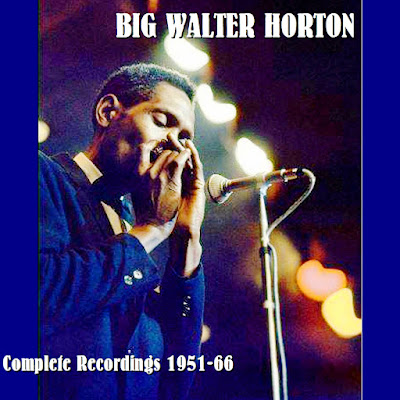
BIG WALTER HORTON/ Complete Recordings 1951-66

BIG WALTER HORTON/ Complete Recordings 1951-66


I guess it's certainly not necessary to present Big Walter Horton, also named Shakey Horton, to the followers of my blog. His reputation is very very high among blues buffs all around the world and particularly among harmonica players and fans for whom he is considered as one of the most accomplished and influential blues harp players of all times.

Heavy or piercing, hazy or precise, the harmonica playing of this "Big" Walter – the main competitor of the other Walter, the so called "Little" – is almost always full of feeling and imagination. Many of his solos are masterpieces and now classics of the genre and have been heavily emulated up to those days.

Although most of his biographies mention his birth date as 6th April 1918 at Horn Lake, Arkansas and Blues/ A regional experience gives a birth certificate (for a named Harton) from September 1921, Big Walter has always appeared to all who saw him, including yours truly, as a much older man than that.


Walter was certainly neither a leader nor a very reliable informant and during most of his career he was equally not a very reliable band player, the stories about how he didn't show at a gig or quit during the middle of a performance abound. And this certainly explains why he never reached any stardom, not even being able to make a living out of his music.

But of course when he was playing or recording, Big Walter was certainly a huge master of his instrument.

I had the opportunity to see him quite often while he was touring Europe either with the AFBF's 1965, 1968 and 1970 or when he was a band member of the Willie Dixon's Chicago Blues all stars. I also had the privilege to meet him in Chicago in 1979 when he was backing Floyd Jones on a tiny West Side club. And we drove him to his shabby home where he was living in ugly poverty while posters on the walls were testifying of his great reputation all around the world!


Anyway, this compilation tries to gather all the recordings he made under his name during the years 1951-66, from his early days in Memphis to his first European tour. Of course all of those have been issued and sometimes still available but scattered on many records with a majority of them out of stock. To have them together seemed to me a very interesting way to appreciate his terrific talents as a musician.

After 1966, Walter made a handful of albums for Alligator (maybe his very best) and with several young (at that time) bands like Hot Cottage or John Nicholas' and even appearing in the best selling album Fleetwood Mac/ Blues jam at Chess. All of those are very worthwhile.

Walter died in Chicago on 8th December 1981. To my eyes, he was certainly older than 60 years old.

                                                 Gérard HERZHAFT


The best online specialized harmonica shop is certainly HARMONICALAND. Try it!
La meilleure boutique spécialisée dans l'harmonica en ligne est certainement HARMONICALAND


dimanche 5 décembre 2021

JOHNNY FULLER/ Complete Recordings 1948-62


JOHNNY FULLER/ Complete Recordings 1948-62


Il y a actuellement un net regain d’intérêt pour l’œuvre de Johnny Fuller et cet article répond donc à plusieurs demandes.

            Né à Edwards dans le Mississippi le 20 avril 1929, une bourgade ferroviaire non loin de Vicksburg, il y a vécu la dure vie des métayers de cette région et de cette époque: enfance chaotique, une poignée d’années d’école et le travail des champs dès l’âge de neuf ans. S’il est possible qu’il ait côtoyé des bluesmen locaux (n’oublions pas que Charlie Patton est originaire de la même localité), Johnny n’a toujours reconnu comme première influence que les musiciens de Country comme Gene Autry (son idole de jeunesse) de la marque duquel il avait obtenu sa première guitare, Jimmie Rodgers et, plus tard, Ernest Tubb.

            Il suit sa mère à Vallejo durant la guerre et trouve immédiatement du travail dans les importants chantiers navals de cette localité de la baie de San Francisco. C’est là qu’il dit avoir pour la première fois entendu du "vrai" blues, le style des innombrables Noirs venus du Texas chercher du travail durant la guerre. C'est dans ce style terrien et profond, immanquablement texan, que Fuller enregistre en 1948 pour le label Jaxyson trois morceaux de Gospel sous le nom de Brother Johnny Fuller. C'est encore dans ce même style texano-californien qu'il démarre vraiment sa carrière de bluesman en 1954 sous la houlette du producteur Bob Geddins qui a remarqué la popularité de ce musicien dans les bars de Oakland. Il enregistre une magnifique série de titres qui demeurent comme des chefs d'oeuvre absolus du downhome blues californien: guitare électrique et vibrante, arpèges dévastatrices, voix mourante, paroles évocatrices et amères. Mais Fuller fait déjà montre de sa grande versatilité et presque en même temps que ces blues, il grave - à la grande satisfaction de Geddins qui veut vendre à un public le plus large possible - des ballades pop comme You got me whistling qui flirte avec les Hit Parades.

            La carrière de Johnny Fuller semble désormais bien lancée et dès la fin de 1954, il abandonne son travail de manoeuvre pour diriger son propre ensemble, jouer et tourner à travers tout le Sud-Ouest. Il enregistre abondamment durant une décennie pour Geddins mais aussi de plus grands labels comme Specialty, Flair, Aladdin, Imperial et Checker, obtenant des succès avec des pièces de plus en plus proches du Rock'n'roll (Haunted house, Train train - une reprise de Mystery train, No more) ou de la pop. Fuller sera d'ailleurs un des très rares bluesmen noirs à interpréter de façon convaincante des morceaux de Rockabilly, un genre où il est d'ailleurs toujours reconnu comme un des leurs!

            Mais cet éclectisme qui lui permet de s'adresser à plusieurs publics à aussi un revers de la médaille: au fur et à mesure que les années 1960 s'avancent, il apparaît pour les uns ou les autres trop blues, trop pop, trop sirupeux, trop rock'n'roll... voire trop "blanc" pour un public de jeunes noirs qui se tournent alors massivement vers la Soul. Un genre auquel s'essaie sans aucunement convaincre Johnny Fuller!

            Et 1967 le voit sans orchestre, sans label, sans engagement notable et totalement négligé par le Blues Revival. Johnny reprend alors un travail d'ouvrier dans un garage, abandonne la musique. En 1973, il est "redécouvert" par Tom Mazzolini et des fans Australiens qui le ramènent dans les studios pour un excellent album enregistré en compagnie de Philip Walker et de son orchestre. Cela ne change malheureusement pas grand' chose pour Fuller qui ne fait que quelques rares apparitions sur scène (notamment le San Francisco blues festival) et ne réenregistrera plus.

            Le 20 mai 1985, il meurt d'un cancer du poumon à Oakland.

            Son oeuvre finalement copieuse est effectivement éclectique mais contient, dans chacun des genres que Fuller aborde, des morceaux de premier plan qu'il est intéressant de pouvoir écouter pour la première fois sur cette intégrale que je vous propose ici.

                                                                       Gérard HERZHAFT


There is a strong renewal of interest towards Johnny Fuller and this article is the answer to several queries from all over the world!

            Born in Edwards, Ms not far from Vicksburg (the same place that Charlie Patton!) on April 20th, 1929, Johnny Fuller has lived there the same usual hard childhood that the other sharecroppers: no education, full work at the age of 9... He said he then started to play the guitar and sing under the influence of Country Music icons like Jimmie Rodgers, Gene Autry and later Honky Tonk singer Ernest Tubb. After a brief stint in New Orleans, Johnny went during the war to the Bay Area, finding work on the shipyards of Vallejo. He said that it was there that he heard the real downhome blues for the first time, a deep Texas blues carried on the West Coast by the thousands of Texans who migrated in California during the war years.

            It is in this very style that Johnny started to play and record, first three Gospel sides in 1948 (one is missing in this comp!), then a batch of incredible deep blues waxed in 1954 for Bob Geddins. Those marvellous sides with devastating arpeggios, vibrant electric guitar licks, dying vocals and bittersweet lyrics stand as masterpieces of the downhome West Coast blues. But at the same time, Fuller is also able to record pop ballads like You Got me whistling, rocking pieces - almost rockabilly - like Haunted house that hits the Top 100 nationwide.

            Fuller then drop his day job and leads his own band, touring the Southwestern States, recording constantly for label as prestigious as Specialty, Flair, Aladdin, Imperial or Checker numerous 45s that mix with equal ease blues (less and less frequently) with ballads, rock'n'roll numbers, doo woop, corny pop pieces...

            But this versatility has also his setback. During the mid-60's, Johnny Fuller is unable to gain the attention of the new mostly white and international public of the Blues Revival as well as the young African-Americans who wants Soul, a genre that Fuller tries to make a hand but with no success.

            And in 1967, Johnny is forced to stop his musical career and work as an auto mechanic in the Bay Area, largely forgotten by the blues world. In 1973, thanks to Tom Mazzolini, he is rediscovered by a group of Australian fans and record a very good album for an Ossie label with Philip Walker and his band. Unfortunately, this record doesn't do too much for Fuller who appears only sporadically on stage (SF blues Festival) and won't record anymore.

            On 20th of May 1985, he dies of a lung cancer in Oakland.

            His recorded output has only been reissued partly and raggedly. This .mp3 comp gather all his records in chronological order and thus allows to fully appreciate his very often first rate works.

                             Gérard HERZHAFT


JOHNNY FULLER/ Complete Recordings 1948-62

Brother Johnny Fuller, vcl/g; pno. Oakland, Ca. 1948

Poor pilgrim of sorrow

01. I must tell Jesus

02. From bad to worse

Johnny Fuller, vcl/g; George Hurst, pno/vcl on *; Walter Robinson, hca; Eugene Keel, bs; Tommy Ramerson, dms. San Francisco, Ca. mars 1954

03. Hard times

04. Buddy*

05. Back home

06. It's your life

07. Prowling blues

08. Johnny low's down blues

Johnny Fuller, vcl/g; Eugene Keel, bs; Tomy Ramerson, dms. San Francisco, Ca. avril 1954

09. These young girls

10. I walk all night

Johnny Fuller, vcl/g; band. San Francisco, Ca. juin 1954

11. Fool (Fool's paradise)

12. First stage of the blues n°1

13. Lovin' lovin' man

14. Remember

Johnny Fuller, vcl/g; Walter Robinson, hca; saxes; George Hurst, pno; Robert Dixon, bs; Tommy Ramerson, dms. novembre 1954

15. Train train blues

16. Bad luck overtook me (Black cat)

17. Troubles (Mean old world)

18. How long

19. Sunny road

20. I can't succeed

21. Too late to change

22. Roughest place int own

23. My mama told me

24. Coming around the corner

25. Johnny Ace's last letter

Johnny Fuller, vcl/g; band. Los Angeles, Ca. mars 1955

26. Cruel cruel world

27. My heart beats for you

Johnny Fuller, vcl/g; Que Martyn, t-sax; George Hurst, pno; Robert Dixon, bs; Tommy Ramerson, dms. San Francisco, Ca. 2 septembre 1955

28. Garden of memories

29. Mercy mercy

Johnny Fuller, vcl/g; Lee Allen, t-sax; Alvin "Red" Tyler, b-sax; Salvador Doucette, pno; Frank Fields, bs; Earl Phillips, dms. New Orleans, La.  janvier 1956

30. Don't slam that door

31. Sister Jenny

32. My heart is bleeding

33. Restless

Johnny Fuller, vcl/g; Al Reed, pno; Justin Adams, g; band. New Orleans, La. 21 août 1956

34. Heavenly love

35. Deep in my soul

36. Whispering wind

37. Stop look and listen

38. Miss you

Johnny Fuller, vcl/g; band. San Francisco, Ca. décembre 1956

39. Strange land

40. Weeping and mourning

Johnny Fuller, vcl/g; CandyMan Mc Guirt, pno; George Hurst, g; Willie Moore, t-sax; Floyd Montgomery, bs. Henry Bess, dms. San Francisco, Ca. 1957

41. No more no more

42. First stage of the blues n°2

43. You got me whistling

44. All night long

Johnny Fuller, vcl/g; George Hurst, pno; og; bs; Tommy Ramerson, dms. Los Angeles, Ca. avril 1958

45. Haunted house n°1

46. The mighty hand

Johnny Fuller, vcl/g; band. Los Angeles, Ca. octobre 1958

47. Swinging at the creek

48. Many rivers mighty seas

Johnny Fuller, vcl/g; band. San Francisco, Ca. 1960

49. She's too much

50. No more loving

51. Wyatt Earp shot Stagger Lee

52. Haunted house n°2

Johnny Fuller, vcl/g; band. San Francisco, Ca. 1962

53. The power

54. No more